
Quebec, Canada
Registration Year
Registered Sector
Historical Function
Administrative Status
News
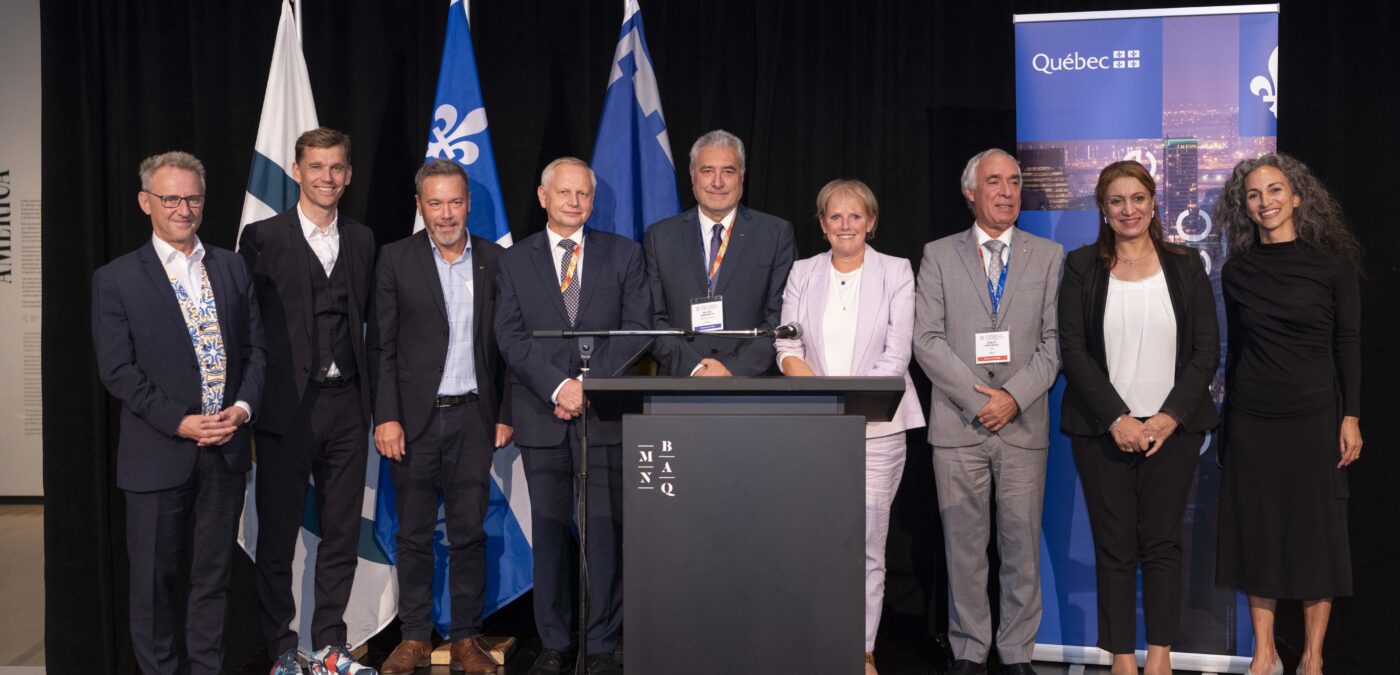
- The Board of Directors and the regional coordinators of the OWHC
- International symposium: Capitial Cities and Heritage in the XXIst Century
- The OWHC offers a commemorative plaque to the City of Quebec
- New employee at the OWHC
- SHA Québec 2014 - 47th Conference on Historical and Underwater Archaeology
Links
Location and site
Historical Reference
- Upon his arrival at the site known today as Quebec City, Samuel de Champlain, its founder, constructed the "habitation" (dwelling) at the foot of the promontory. In 1620, a fort was erected at the summit of this 70 m. high escarpment. The habitation and the fort were the two nuclei around which the city's future growth was to take place.
- The Upper City ("Haute Ville") and Lower City ("Basse Ville") are distinguished by their specific functions: the former became the centre for administrative and religious activities, while the latter was the business centre. After a series of battles over access to fur trading territories, the port of Quebec City enjoyed, thanks to the export of the products of this trade, a first period of growth.
- The threat imposed by the British led to the construction of the fortification walls in 1695. Their reconstruction in 1720 followed the limits of the area known today as the Upper City. By the time of the British Conquest in 1759, the narrow strip of land at the base of the escarpment had been entirely settled.
- The Americans besieged Quebec City in 1775. To prevent further attacks, a citadel overlooking the St. Lawrence River was constructed between 1819 and 1831. By the end of the 19th century, the city's port was at the peak of its activity.
Urban Morphology
The Citadel, a star-shaped bastioned enclosure, limited the expansion of Quebec's Upper City. The city's complex plan, with its multiple angles and axes, adapts to the difficult topography of the 135-hectare site. Narrow streets, often in a rectilinear grid, surround urban squares and parks and offer unexpected views of the river. A main artery runs along the shore. Located near the riverbanks, the oldest areas of the city and their houses date to the 17th and 18th centuries. The Upper City, which makes up a large portion of the historic site, possesses mostly early 19th-century buildings of Neo-Classical inspiration. Among the noteworthy monuments that stand out among the stone house are the Chƒteau Frontenac (1892) and a number of churches and educational institutions. The silver roofs of the Seminary, originally constructed in 1663 and enlarged and restored several times since, continue to reflect the city's different seasons.
Registration Criteria
"[...] Quebec's historic district, including the citadel, the Upper City defended by the walls with bastions and the Lower City with its harbour and old quarters, provides us with an eminent example of a fortified colonial town, which is by far the most complete in North America." (IV) "The fomer capital of New France, Quebec illustrates one of the major stages in population and growth of the Americas during the modern and contemporary period." (VI)
Contact
| Monsieur Régis Labeaume Maire de Québec | Ville de Québec 2, rue des Jardins, bur. 115 Québec, (Québec), Canada G1R 4S9 | Tel: +1.418 641.6434 Fax: +1.418 641.6318 Email: mairie@ville.quebec.qc.ca |
| Madame Julie Lemieux Comité Exécutif - Responsable des dossiers de la Culture et Patrimoine | 2, rue des Jardins, bureau 104 Québec, Québec, Canada G1R 4S9 | Tel: 418.641-6411 poste 1043 Fax: 418.641-6455 Email: julie.lemieux@ville.quebec.qc.ca |
| M. Denis Desrosiers Directeur | Bureau des relations internationales de la Ville de Québec 2, rue des Jardins Québec, Québec, Canada G1R 4S9 | Tel: (418) 641-6411 Fax: (418) 641-6437 Email: denis.desrosiers@ville.quebec.qc.ca |
| Mme Sarah-Ève Huot Conseillère en relations internationales | Bureau des relations internationales de la Ville de Québec 2, rue des Jardins Québec, Québec, Canada G1R 4S9 | Tel: (418) 641-6411 #1512 Fax: (418) 641-6437 Email: sarah-eve.huot@ville.quebec.qc.ca |
| Madame Odile Roy Directrice | Division Design, architecture et patrimoine 295, boul. Charest Est 1er étage, bureau 162 Québec, Québec, Canada G1R 3G8 | Tel: +1.418 641.6411 ext. 2120 Fax: +1.418 641.6455 Email: odile.roy@ville.quebec.qc.ca |
| M. Jacques Faguy Directeur de la Division de la gestion du territoire | Arrondissement de La Cité, Ville de Québec 399, rue Saint-Joseph Est, 4e étage Québec, Québec, Canada G1K 8E2 | Tel: +418 641-6101 poste 3150 Fax: +418 641-6583 Email: jacques.faguy@ville.quebec.qc.ca |
| M. William Moss Archéologue principal | Service de l'aménagement du territoire 295, boul. Charest Est, bureau 165 Québec, (Québec), Canada G1K 3G8 | Tel: +1.418.641.6411, poste 2149 Fax: +1.418.641.6455 Email: william.moss@ville.quebec.qc.ca |


