

Strasbourg, France
General Information
Administrative status
Seat of the Council of Europe and of the Assembly of European Communities; chief city of two districts.
Strasbourg, Grande-Île and Neustadt
Registration Year
1988
Historical function
Trade and culture.
Location and site
In the heart of Europe, Strasbourg was a crossroads for the Rhine River and terrestrial trade routes. The old city is constructed between two arms of the Ill River.
Urban morphology
The old city of Strasbourg occupies an island, Grande-Île. Throughout its urban history, its two Roman axes have been maintained. The streets, which vary in width, are organized in a compact grid according to a plan which is almost rectilinear. Today, 20 bridges connect the old city of Strasbourg to the shores of the Ill River.
The old city centres around its Gothic cathedral of red sandstone. The older squares within this dense urban fabric are bordered with palaces, hotels, institutions and half-timber houses. Harbours extend along the two arms of the Ill River. Upstream from Grande-Île are a series of fortified bridges and their three towers.
Registration criteria
Criterion (ii): French and Germanic influences have shaped the Grande-Île and Neustadt. They have enabled the emergence of a unique expression coming from the two cultures, which is especially conveyed in the fields of architecture and urbanism. The cathedral, influenced by the Romanesque art of the East and the Gothic art of the kingdom of France, is a model that acted as a vector of Gothic art to the east. […]
Criterion (iv): The Grande-Île and the Neustadt in Strasbourg constitute a characteristic example of a European Rhineland city. Integrated into a Medieval urban fabric in a way which respects the ancient original fabric, the Renaissance-style private residences built between the 15th century and the late 17th century form a unique ensemble of domestic Rhineland architecture, which is indissociable from the outstanding Gothic cathedral.
Historical reference
- Strasbourg was built on the site of the castrum Argentoratum, which was established in 12 B.C. and served as part of the Roman system of defense on the Rhine River.
- In the 5th century, when Alsace was ruled by the Franks, the devastated site was known as Stratisburgum (meaning “roadside town”).
- When the Bishops still had authority in the town, the Carolingians built the first church. Until 1000, the Roman fortifications enclosed the town, and a new fortification wall was constructed around 1100. In the 13th century, the rule of the Bishops was replaced by that of the bourgeois.
- Strasbourg became a wealthy city due to its strategic position on the Rhine. Its growing autonomy allowed it to become a free city of the empire; it obtained the privilege of hosting a fair and became one of Europe’s warehouses on the Rhine.
- From the 15th century on, the economic development of Strasbourg was accompanied by political and intellectual enlightenment.
- In 1681, when Strasbourg was experiencing troubled times, Vauban constructed a fortress. In the 18th century, its population grew at an impressive pace.
Photos

News
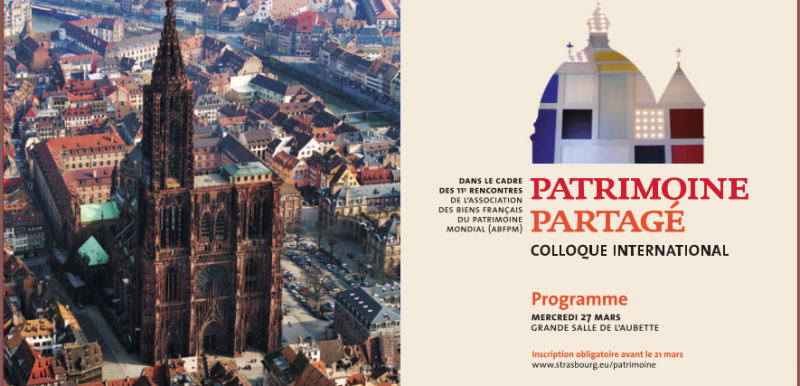
21 February 2013
Strasbourg, France will host the international conference « Shared Heritage » on 27 March 2013
Strasbourg, France

7 September 2011
International Conference – Heritage and Public Transport – Strasbourg, Tuesday October 11th 2011
Strasbourg, France
Contact
Mme Catherine Trautmann
Maire de Strasbourg
Ville et Communauté urbaine
1, parc de l'Etoile
Strasbourg, Cedex, France
67076
+33 (0)3 68 98 50 00
Mme Marion Baudry
Chargée de mission Patrimoine
Ville et Eurométropole de Strasbourg
Le 5e Lieu - 5 place du Château
Strasbourg, France
67000
+ 33 (0)3 68 98 52 15
[email protected]
Mme Suzanne Brolly
Adjointe à la Maire de Strasbourg, en charge de la ville résiliente - Vice-présidente en charge de la politique de l’habitat et de la stratégie foncière et immobilière
Ville et Eurométropole de Strasbourg
1, Parc de l'Étoile
Strasbourg, France
67076
Find Us

Espace Quatre Cents
100, Quai Saint-André, Bureau 140
Québec (Québec) G1K 3Y2
Canada
+1 418 692-0000
Confidentiality Policy
Social Media Policy