
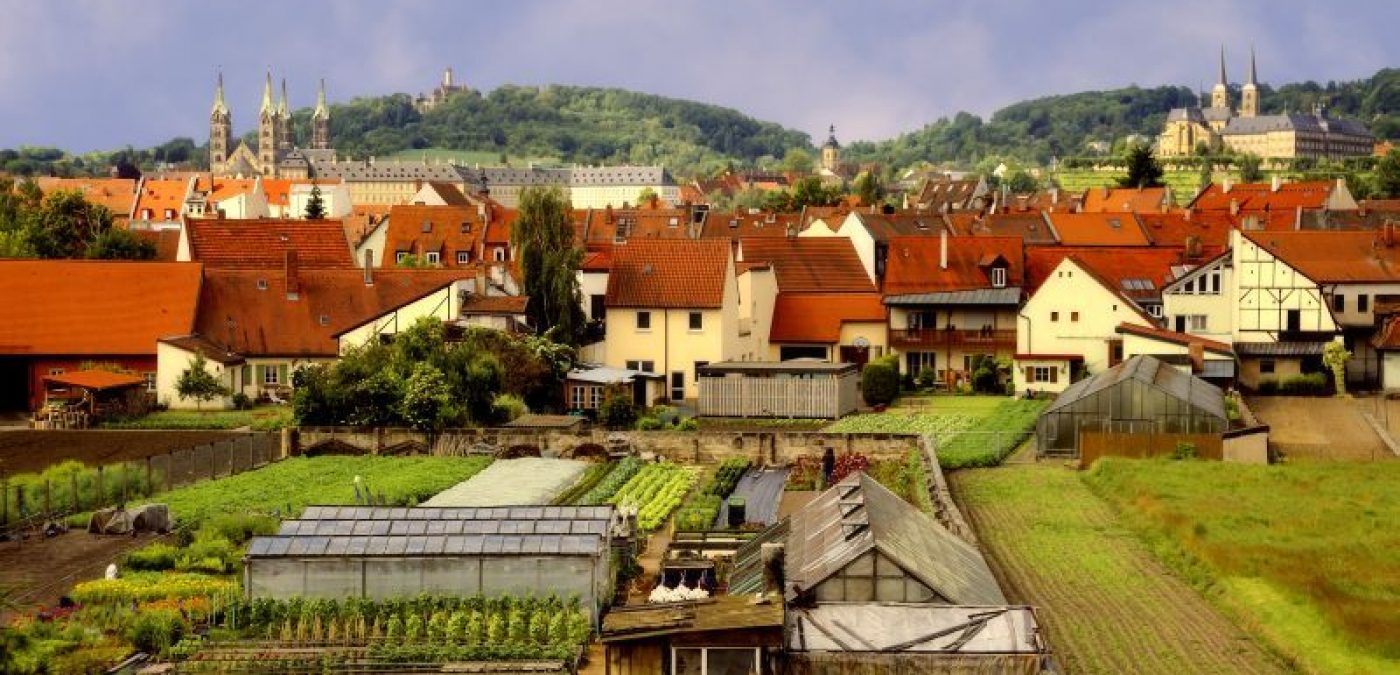
Bamberg, Germany
Registration Year
Registered Sector
Historical Function
Administrative Status
Mayor of Bamberg

Andreas Starke
News
Location and site
Historical Reference
- In the 9th century, Bamberg was the residence of the counts of Babenberg. This was a period of dismemberment for the Carolingian Empire and a time of power struggles within the Kingdom of Germania.
- The bishop's palace was established at Bamberg in 1007 by Henry II, the Duke of Bavaria and Germanic Emperor from 1002 until 1024; this served political and religious purposes that were European in magnitude. At this time, Bamberg attained the status of a city. Several abbeys and churches were constructed. The city developed according to a cruciform model.
- In the 12th and 13th centuries, Bamberg developed under the authority of the Prince-Bishops. The magnificent restoration of its cathedral, which was erected in 1007, reflected its commercial prosperity.
- At the end of the Middle Ages, Bamberg's economic and artistic importance had not diminished. Its port served as the point of departure for transport along the Main River. Dissension existed between the burghers and the princes, and the city evolved around several nodes.
- Cultural and artistic activity was intense at the end of the 17th century and during the 18th century. The influence of the Enlightenment spread to the south of the country at the end of the 18th century. Numerous Baroque monuments were constructed; these included religious buildings (such as Saint Martin's Church) and, especially, civic buildings (including the New Residence and the city hall).
- In 1803, Bamberg became part of Bavaria and its intellectual life flourished.
Urban Morphology
The city of Bamberg, part of which is surrounded by fortifications, is composed of three centres: the hills of Bergstadt (11th century) are dominated by the cathedral; the island of Inselstadt (12th century) is the market place; and the south bank of the river, known as Theuerstadt (Middle Ages), includes the market garden. A church marks each extremity of the cruciform plan which was laid out soon after the city's foundation.
The monuments of Bamberg are of great artistic importance. Its cathedral, which possesses both Romanesque and Gothic features, illustrates a revival as well as an acceptance of the architectural and sculptural art of the cathedrals of Laon and Rheims. Its Gothic architecture influenced northern Germany and Hungary, and Bohemia would be influenced by its Baroque monuments.
Registration Criteria
The layout and architecture of the Bamberg quarters dating to the Middle Ages and Renaissance has exerted a considerable influence on urban form and its evolution in Central Europe from the 11th century. (II) Bamberg is a remarkable and representative example of a city of the early Middle Ages in Central Europe because of both its plan and the large number of religious and secular buildings that it has conserved. (IV)
Contact
| Mr. Andreas Starke Mayor of Bamberg | City of Bamberg Rathaus Maxplatz Bamberg, Germany | Tel: +49.951 87.10.00 Fax: +49.951 87.19.75 Email: Oberbuergermeister@Stadt.Bamberg.de |
| Mrs. Dr.-Ing. Ulrike Laible World Heritage Manager | City of Bamberg - Centre World Heritage Geyerswörthstr. 3 Bamberg, Bavaria, Germany 96047 | Tel: +49951/87-1811 Fax: +49951/87-1983 Email: Ulrike.laible@stadt.bamberg.de |
| Mr. Michael Ilk Councillor For Builduig Affairs | Baureferat der Stadt Bamberg Postfach 110215 Untere Sandstrasse 34 Untere Sandstrasse 34 Bamberg, Germany 96049 | Tel: +49.951 87.16.00 Fax: +49.951 87.19.54 Email: michael.ilk@stadt.bamberg.de |
| Mrs. Diana Büttner Ing. | City of Bamberg - Centre World Heritage Geyerswörthstr. 3 Bamberg, Germany 96047 | Tel: +49951/87-1814 Fax: +49951/87-1983 Email: diana.buettner@stadt.bamberg.de |


