

Rhodes, Greece
General Information
Administrative status
Chief city of the Island and of the Dodecanese administrative region
Medieval City of Rhodes
Registration Year
1988
Historical function
Defense.
Location and site
In the northeast of the Island of Rhodes, the medieval city of the same name opens into a harbour bay. Very close to Anatolia and not far from the Levant, Rhodes was on the maritime routes of the Mediterranean eastern civilisations, as well as on those of the entire Mediterranean.
Urban morphology
The upper city is made up mostly of rectilinear streets organized around a main artery. The lower city, which is much broader and irregular in shape, is crossed by arteries, streets and lanes that lead to small squares. A 4 km. long rampart dating to the early 14th century surrounds both parts of the city.
The density of monuments in the two parts of the city is impressive. The “collachium,” or the upper city where the Knights resided, is the most monumental; it contains the Place of the Great Masters, the inns of the Knights and the hospital. The “borough,” or lower city, is larger and contains, in addition to other buildings dating to the period of the Knights’ occupation, Islamic monuments from the Turkish period, including mosques, a bath, and vaulted lanes.
Registration criteria
Criterion (ii): The fortifications of Rhodes, a “Frankish” town long considered to be impregnable, exerted an influence throughout the eastern Mediterranean basin at the end of the Middle Ages.
Criterion (iv): This cultural property is an outstanding example of an architectural ensemble which illustrates the significant period of history in which a military/hospital order founded during the Crusades survived in the eastern Mediterranean area in a context characterised by an obsessive fear of siege. Rhodes is one of the most beautiful urban ensembles of the Gothic period. […]
Criterion (v): With its Frankish and Ottoman buildings the old town of Rhodes is an important ensemble of traditional human settlement, characterized by successive and complex phenomena of acculturation. Contact with the traditions of the Dodecanese changed the forms of Gothic architecture and building after 1523 combined vernacular forms resulting from the meeting of two worlds with decorative elements of Ottoman origin. […]
Historical reference
- In the 3rd century B.C. Rhodes constituted a major maritime power and an important centre of Hellenistic civilisation.
- At the time of the Crusades, it was a port of call for Christian ships.
- The Knights of Saint John of Jerusalem berthed there in 1306 when Rhodes was ruled by the Genoese. In 1291, the Knights had lost Rome’s last remaining Holy Land bastion, the Fortress of Saint Jean d’Acre.
- The hospital and military order of Saint John of Jerusalem occupied Rhodes between 1309 and 1523. During this period, the city had a reputation for impregnability; the Knights defended it successfully against seiges by the Sultan of Egypt in 1444 and against Mehmet II in 1480.
- In 1522, however, following a long seige, they surrendered to Soleyman II; from then on, Rhodes was ruled by the Ottomans until 1912.
Photos

News
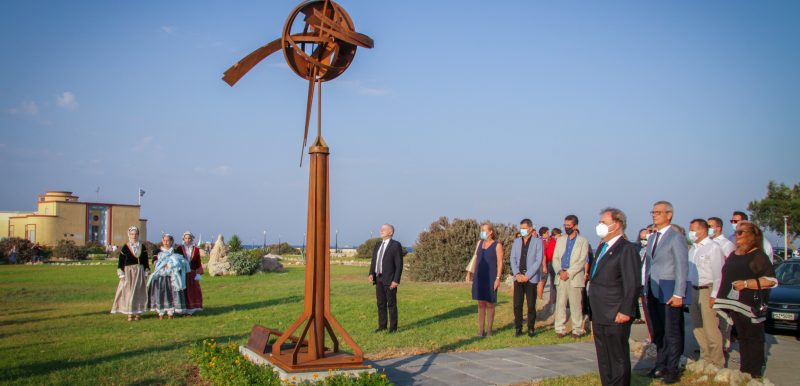
1 October 2020
Celebration of the Solidarity Day of the World Heritage Cities in Rhodes
Rhodes, Greece
Eastern and Central Europe
OWHC Day
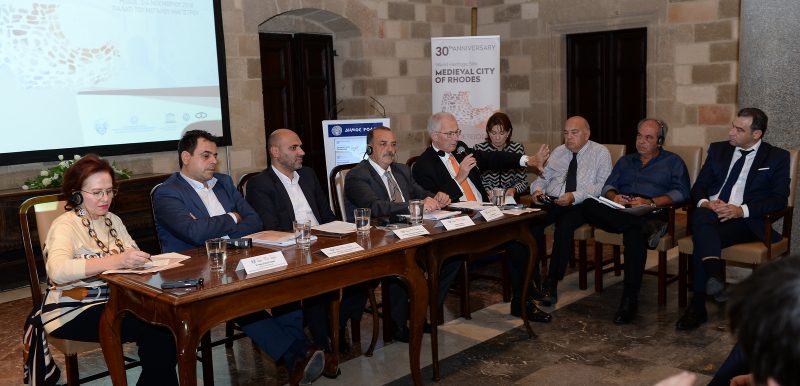
Contact

Mr. Alexandre Basile Coliadis
Mayor
Municipality of Rhodes
Platia eleftherias 1
Rhodes, South Aegean, Greece
85100
+30 22413-61323
[email protected]
Ms. Polly Chatzimarkou
Special Consultant to the Mayor of Rhodes
Municipality of Rhodes
Platia Eleftherias 1 Rhodes
Rhodes, South Aegean, Grèce
85100
+30 224136 1338
[email protected]
Find Us

Espace Quatre Cents
100, Quai Saint-André, Bureau 140
Québec (Québec) G1K 3Y2
Canada
+1 418 692-0000
Confidentiality Policy
Social Media Policy