
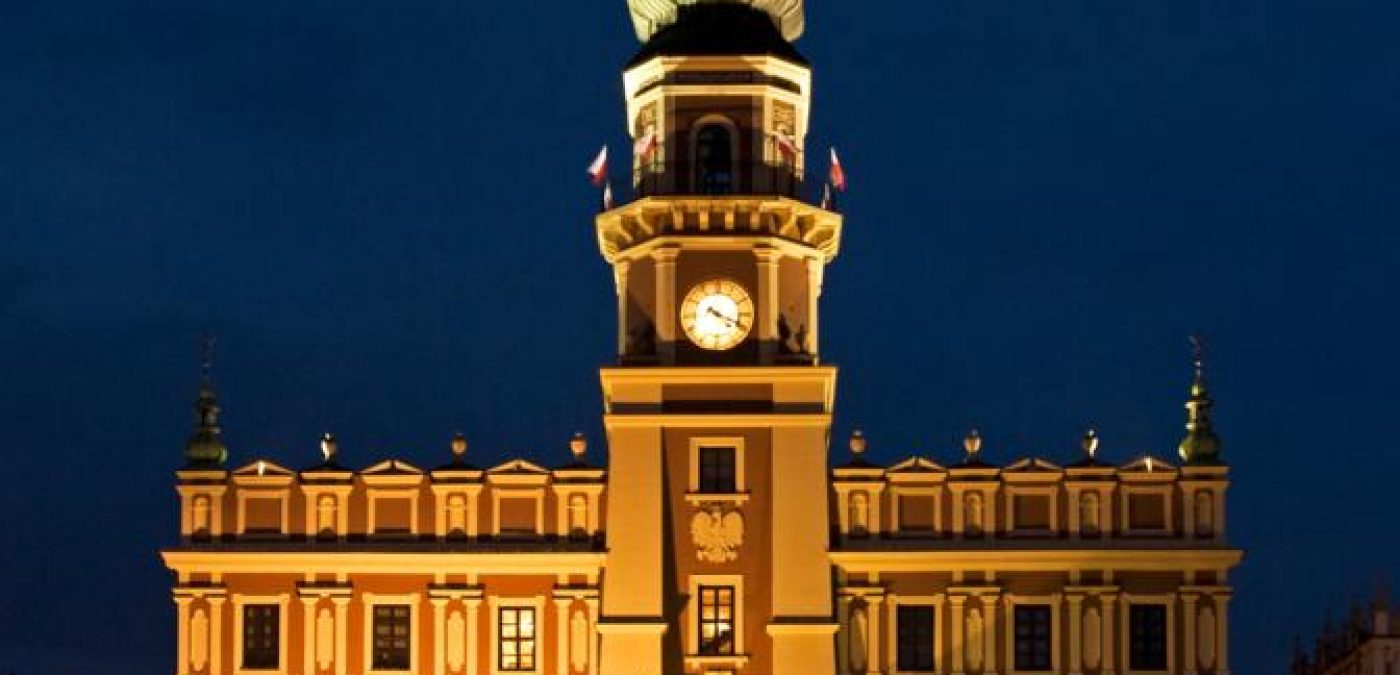
Zamosc, Poland
Registration Year
Registered Sector
Historical Function
Administrative Status
News
Location and site
Historical Reference
- Poland enjoyed its heyday in the 16th century, under the last Jagello kings. Its territory grew to include eastern Prussia (1525), Mazovia (1526), Livonia and Latvia (1561), Courland (1526) and Lithuania (1569). Its cities flourished during the Renaissance.
- After the extinction of the Jagello Dynasty in 1572, the Kingdom became subject to elections. At the instigation of Jan Zamoyski (1541-1605), the gentry, which had difficulty confirming its rights in the 15th century, participated in the royal election. It possessed, along with the high clergy, a monopoly over real estate.
- Zamoyski was a magnate, a politician and a humanist, and Zamosc was his personal creation. Established on his private domain, the city was designed for the purpose of trade and private residence. He erected his palace and the rest of the project took form over a nine year period between 1582 and 1591. Fortifications were built around the ensemble. In 1594, Zamoyski founded an Academy that became a Polish centre of culture.
- At the end of the 18th century, Zamosc went into a long period of decline. It was besieged several times during the 17th and 18th centuries.
Urban Morphology
Inside the original foundation walls, the urban plan designed by the Italian Bernardo Morando is very structured. To the west is the Zamoyksi Palace and to the east is the city, with its squares and its regular, open layout, with its two axes intersecting at right angles. New Vauban-type fortification walls, in the form of a star, were erected in the 17th century.
The Renaissance, especially, and the Baroque styles characterise the architecture of the city, which brings together the urban traditions of Central Europe. The Great Market square, in front of the City Hall, is a rich example; it is lined with Renaissance and Baroque residences with stone arcades and portals. Several churches, including a magnificent 16th-century collegiate church, may be found at Zamosc.
Registration Criteria
Zamosc is an exceptional example of a Renaissance city that was designed at the end of the 16th century and has conserved its original plan, its fortifications and a large number of buildings that are particularly interesting or that combine the traditions of Italy and Central Europe. (IV)
Contact
| Mr. Marcin Zamoyski Mayor of Zamosc | Urzad Miasta ul. Rynek Wielki 13 Zamosc, Poland | Tel: +48.84 638.6802, 639.2084 Fax: +48.84 639.3054 Email: mayor@zamosc.um.gov.pl |
| Mr. Tomasz Kossowski Vice-Mayor of Zamosc Town | City of Zamosc Rynek Wielki 13 Zamosc, Poland | Tel: +4884 6772430 Fax: +84 6386802 Email: |
| Mr. Jacek Belz | Department of Promotion and Culture Urzad Miejski ul. Rynek Wielki 13 Zamosc, Poland | Tel: +48.84 639.3073 Fax: +48.84 638.4296 Email: kultura@zamosc.um.gov.pl |
| Ms. Iwona Stopczynska Deputy Mayor | Urzad Miejski ul. Rynek Wielki 13 Zamosc, Poland | Tel: +48.84 638.6802 Fax: +48.84 639.3054 Email: prezydent@zamosc.um.gov.pl |
| Ms. Jan Wojciech Matwiejczuk Chairman of the Council | City Hall of Zamosc Rynek Wielki 13 Zamosc, Poland | Tel: +48.84 627.1173 Fax: +48.84 639.3054 Email: w.matwiejczuk@zamosc.um.gov.pl |


